
You’ve been solving the wrong problem. The timezone isn’t blocking your offshore team—the middleman is.
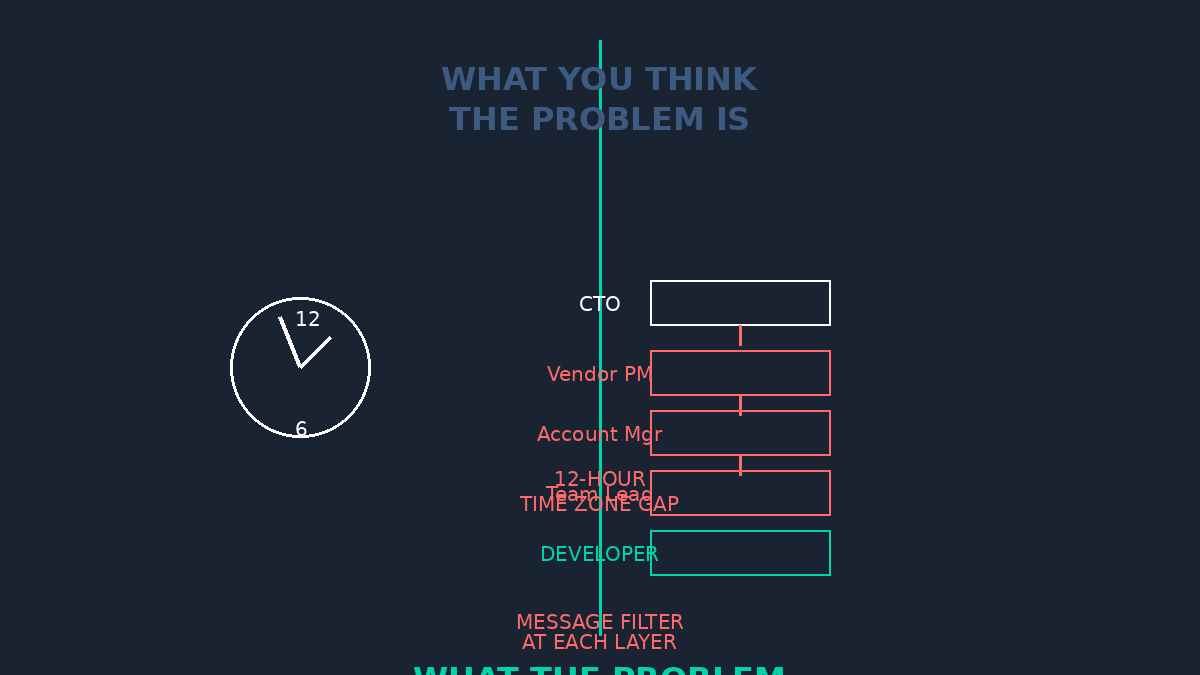
The Myth
87% of CTOs say communication is their #1 challenge with offshore teams. But here’s what the data actually shows.
We blame time zones because it’s easy. The 12-hour gap feels like the obvious villain. It’s there, it’s visible, it’s easy to point to.
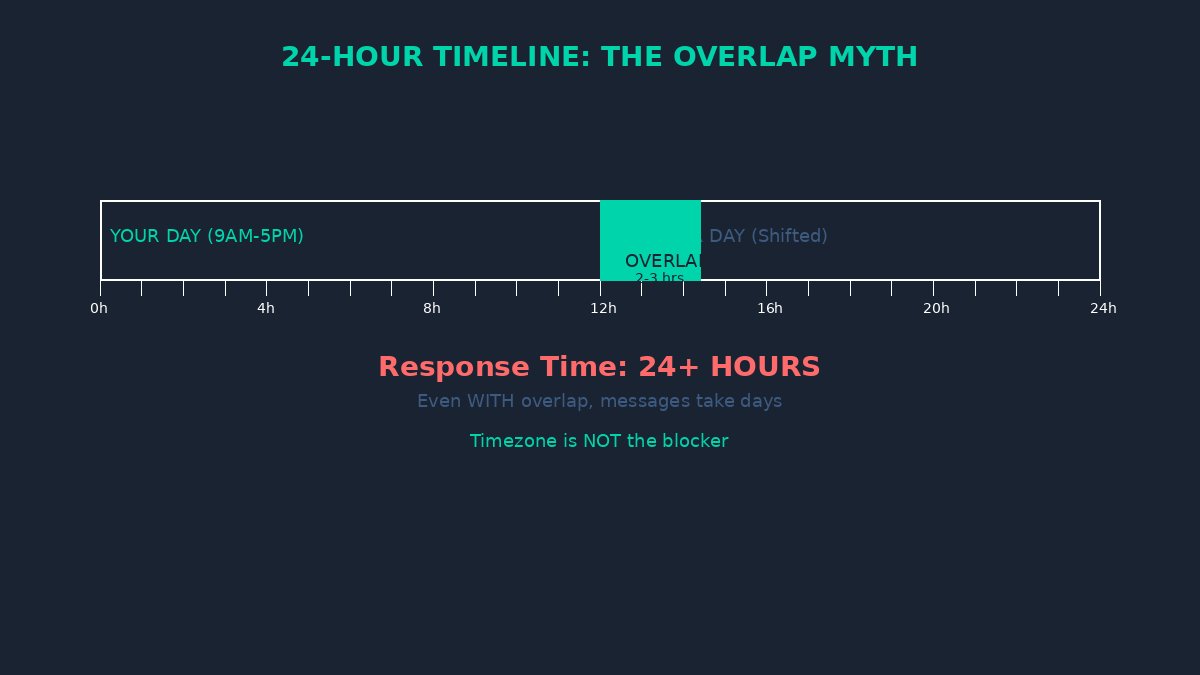
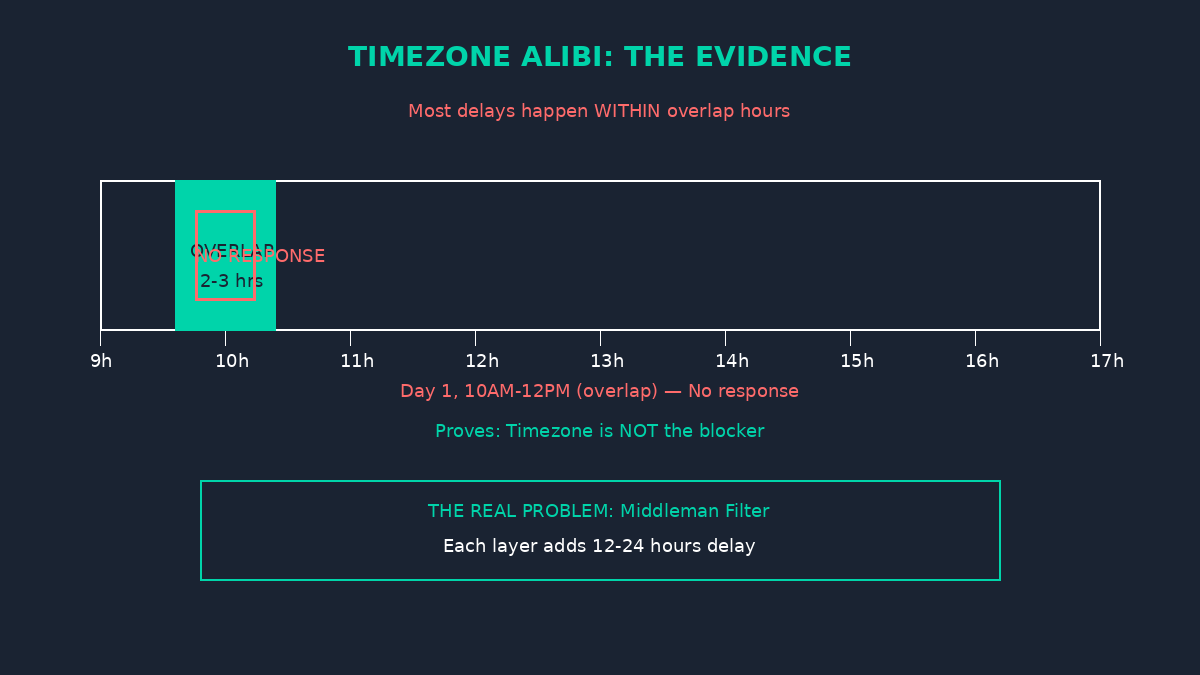
But here’s the uncomfortable truth: most “timezone problems” happen during overlapping hours. Your 9 AM meeting with the offshore team happens at their 9 PM—and somehow that’s still not the problem.
The real issue is invisible. It’s the filtering. It’s the middlemen. It’s the 2-4 layers between your question and the developer’s answer.
The Real Problem — The Middleman Filter
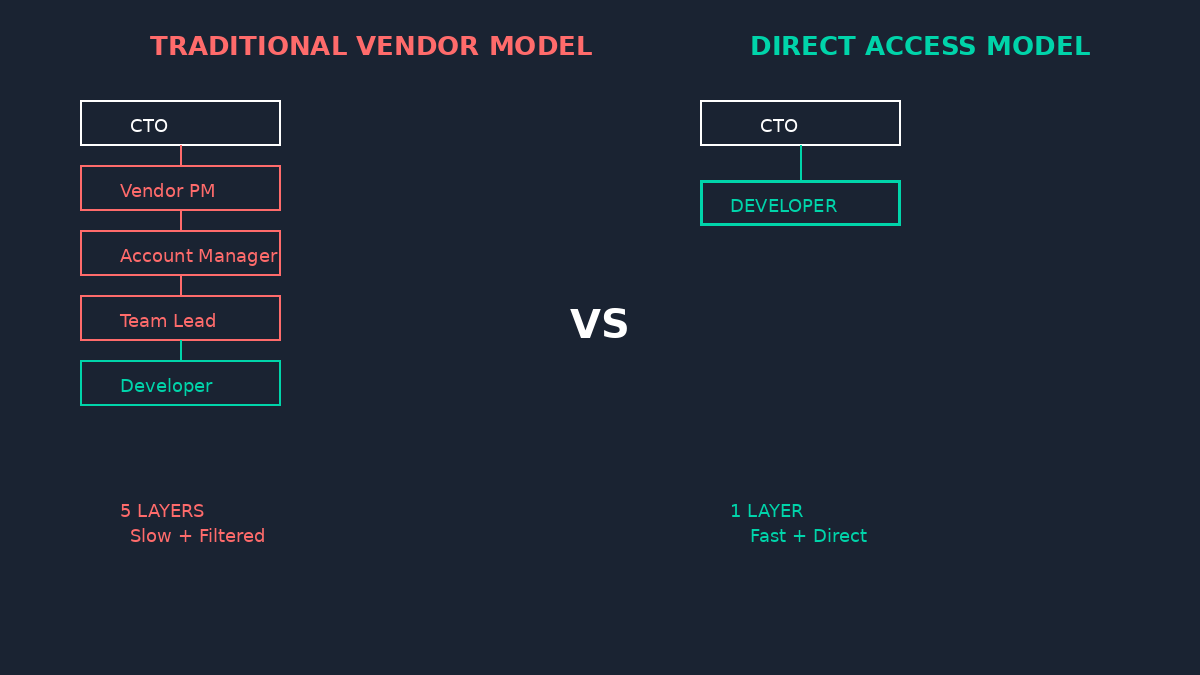
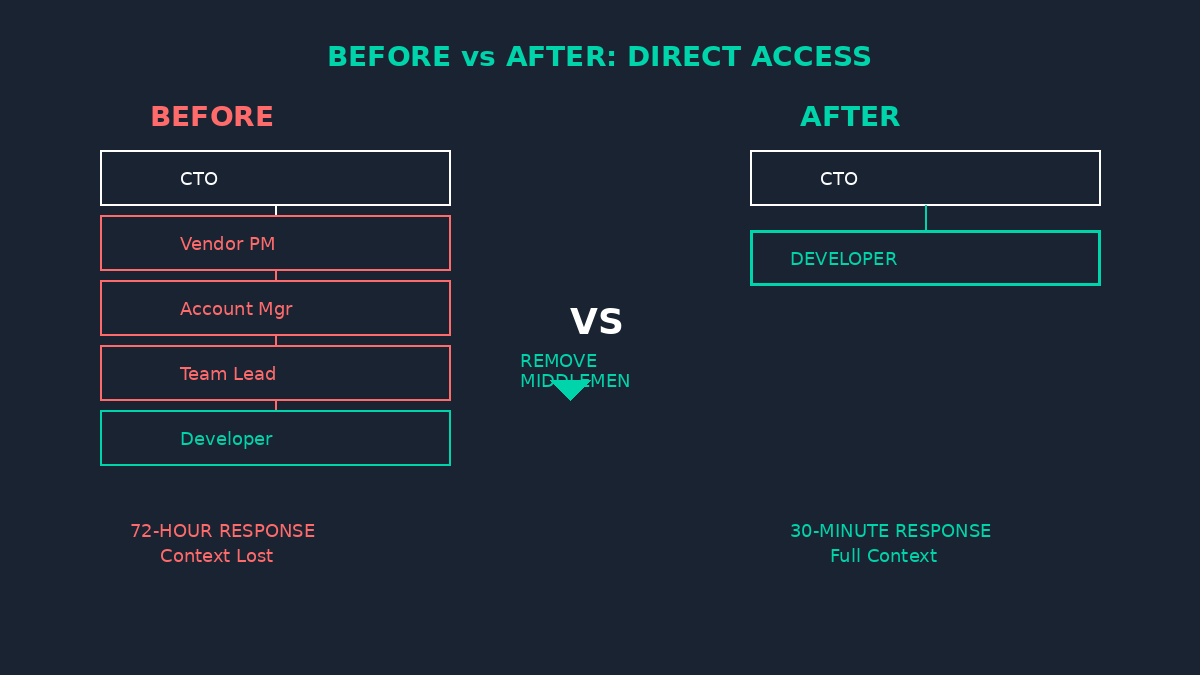
Every message between you and your offshore developers passes through 2-4 middlemen: vendor PM → account manager → team lead → developer.
This isn’t speculation. This is structural. Most offshore vendors operate with layers of management between you and the code. It’s how they scale—one offshore team, multiple clients, each with a “relationship manager” to coordinate.
But here’s what happens at each layer:
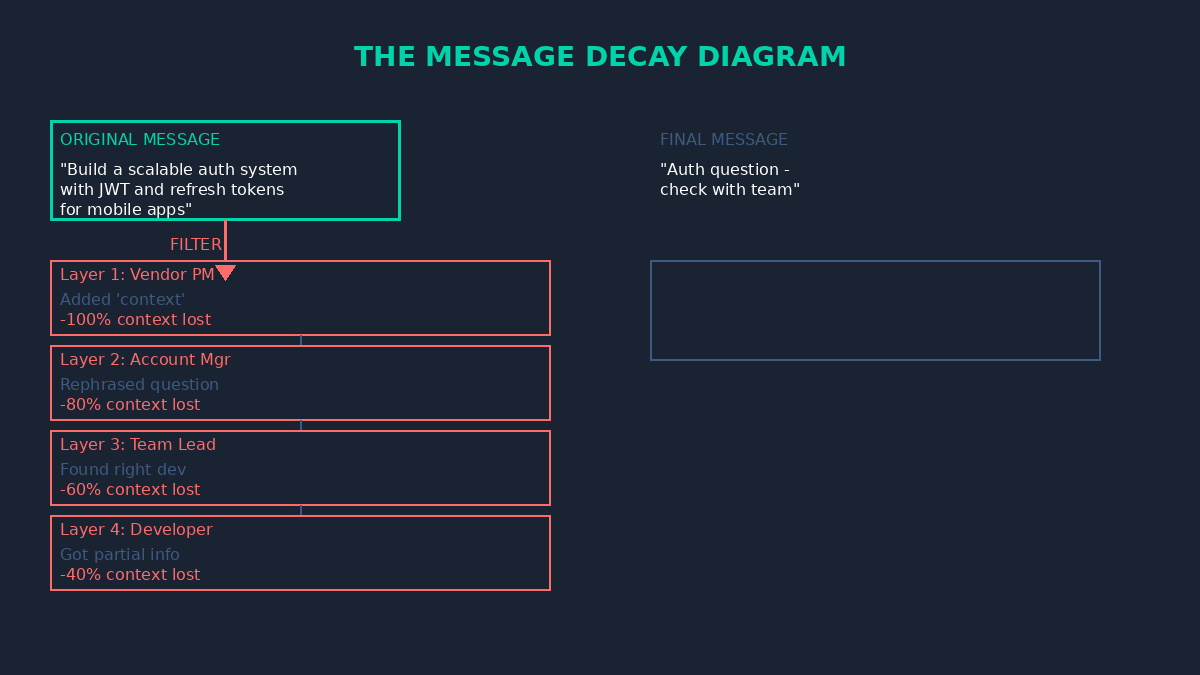
Layer 1 — The vendor PM receives your question. They add their interpretation. They forward it.
Layer 2 — The account manager “adds context” (their context, not yours). They rephrase. They prioritize it against other clients.
Layer 3 — The team lead receives a filtered message. They may or may not understand the technical nuance. They find the right developer—who’s already done for the day in their timezone.
Layer 4 — The developer gets a version of your question that may have lost critical technical details. They answer based on what they received.
Then it bounces back up. Each layer adds their interpretation. By the time it reaches you, the answer may not even address what you asked.
FullScale.io reports that “simple architecture questions take 24 hours, not because of time zones, but because they bounce through three people first.” That’s the middleman filter in action.
The Anatomy of a Communication Failure
Let’s walk through a real example. This happens every day in offshore engagements:
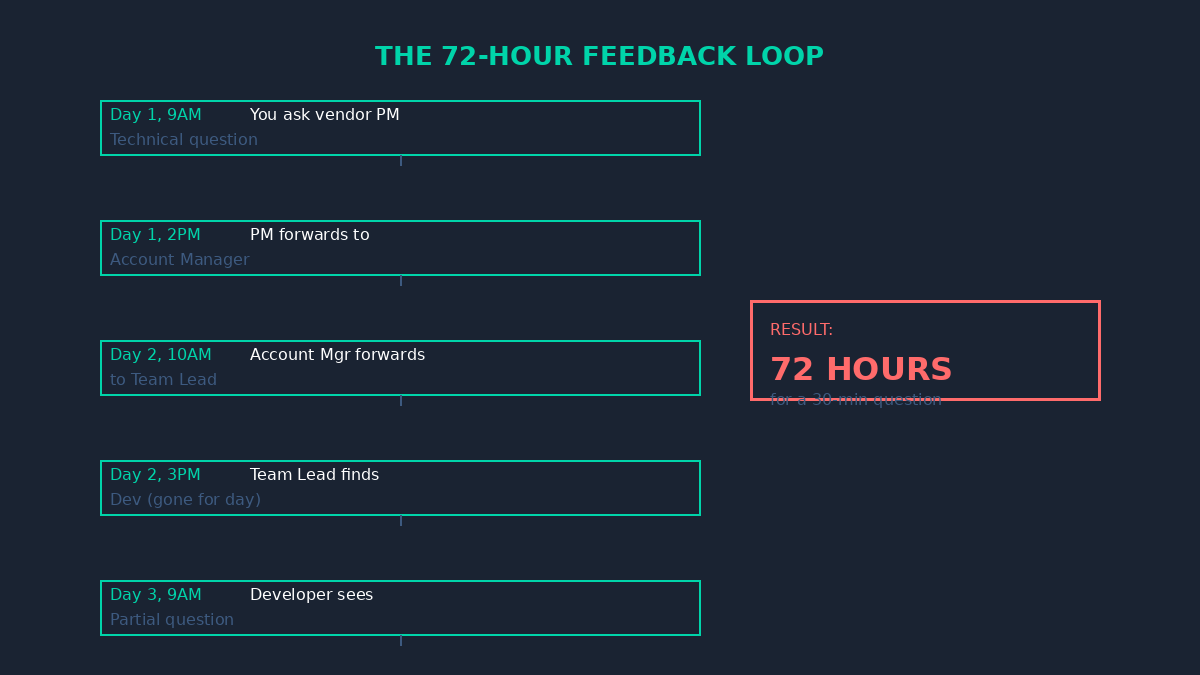
Day 1, 9:00 AM (your time): You ask the vendor PM a technical architecture question about the microservices pattern you’re considering. You need to know if the offshore team has experience with it before you commit to the approach.
Day 1, 2:00 PM (their time): The vendor PM forwards your question to the account manager, adding: “Client is asking about architecture — seems important, can you prioritize?”
Day 2, 10:00 AM (their time): The account manager forwards to the offshore team lead, with their own “context”: “Client wants to discuss some technical approach. Please provide options.”
Day 2, 3:00 PM (their time): The team lead finds the right developer—but they’ve already left for the day. The message sits in Slack.
Day 3, 9:00 AM (their time): The developer sees the question. They’ve got partial information at best. They provide an answer based on what they received.
Day 3, 2:00 PM (their time): The answer bounces up through team lead, account manager, vendor PM. Possibly reformulated at each layer.
Day 3, 5:00 PM (your time): You receive an answer. It’s decent, but not quite what you asked. There’s context missing. You need to ask a follow-up.
Result: 72 hours for a question that should take 30 minutes. And this is a “simple” architecture question. Imagine debugging a production issue with this feedback loop.
What CTOs Get Wrong About Timezones
The timezone argument assumes three things:
1. Messages can only be sent during overlap. False. Async tools exist. Slack, GitHub comments, Loom videos, written specs—none of these require real-time communication.
2. The problem is delay. False. The problem is filtered information. Even in the 2-3 hour overlap window, messages still take 24+ hours to get answered. If it were purely a timezone issue, overlap hours would be fast. They’re not.
3. Moving teams closer would solve it. False. Middlemen exist at home too. If your vendor is in the same timezone but still has 3 layers between you and developers, you still have the same problem.
The uncomfortable truth: if you had direct Slack access to offshore developers, you’d solve 80% of “communication problems” instantly. Not because of timezone. Because of access.
The Solution — Structural Access
The fix isn’t moving timezones or hiring in “better” regions. The fix is structural: removing middlemen to get direct developer access.
Here are three models that work:
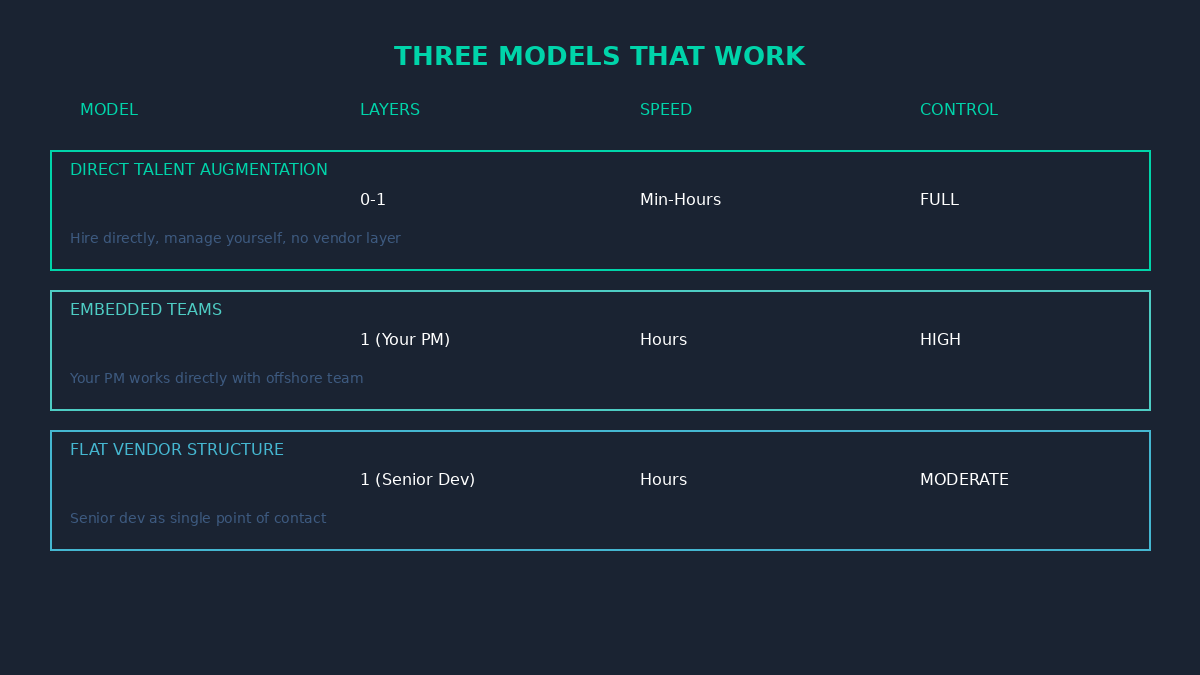
Model 1: Direct Talent Augmentation
Hire developers directly. No vendor layer. You manage them the same way you manage your in-house team. They join your Slack. They attend your standups. They report to your tech lead.
- **Layers:** 0-1 between CTO and developer
- **Communication speed:** Minutes to hours
- **Control:** Full
Model 2: Embedded Teams
Your PM works directly with the offshore team. No vendor PM between you and the code. Your project manager becomes the single point of contact—but that PM talks directly to developers, not through layers of vendor management.
- **Layers:** 1 (your PM only)
- **Communication speed:** Hours
- **Control:** High
Model 3: Flat Vendor Structure
Only 1 layer between you and developers: a senior developer or tech lead who carries the conversation, not a PM who manages it. You skip the account managers and project coordinators entirely.
- **Layers:** 1 (senior dev/tech lead)
- **Communication speed:** Hours
- **Control:** Moderate
Any of these three models removes the middleman filter. The common thread: direct access to the people who write your code.
What Direct Access Actually Looks Like
Concrete example: You message a developer directly on Slack at 2:00 PM your time (their 2:00 AM). You ask a technical question about the caching layer.
By 2:30 PM, they respond: “Good question. Let me check the current implementation. Here’s what I found—[detailed technical response with code references].”
No translation loss. No context stripping. No waiting for the next day’s standup to “raise it with the team.” You get an unfiltered technical answer in 30 minutes.
The offshore team becomes an extension of your org, not a vendor relationship. They see your messages directly. They understand your priorities directly. They answer you directly.
GTCatalyst clients report 85% reduction in “communication issue” tickets after switching to direct access. Not because the team got better—they got access. That’s the difference.
How to Evaluate Vendors for Direct Access
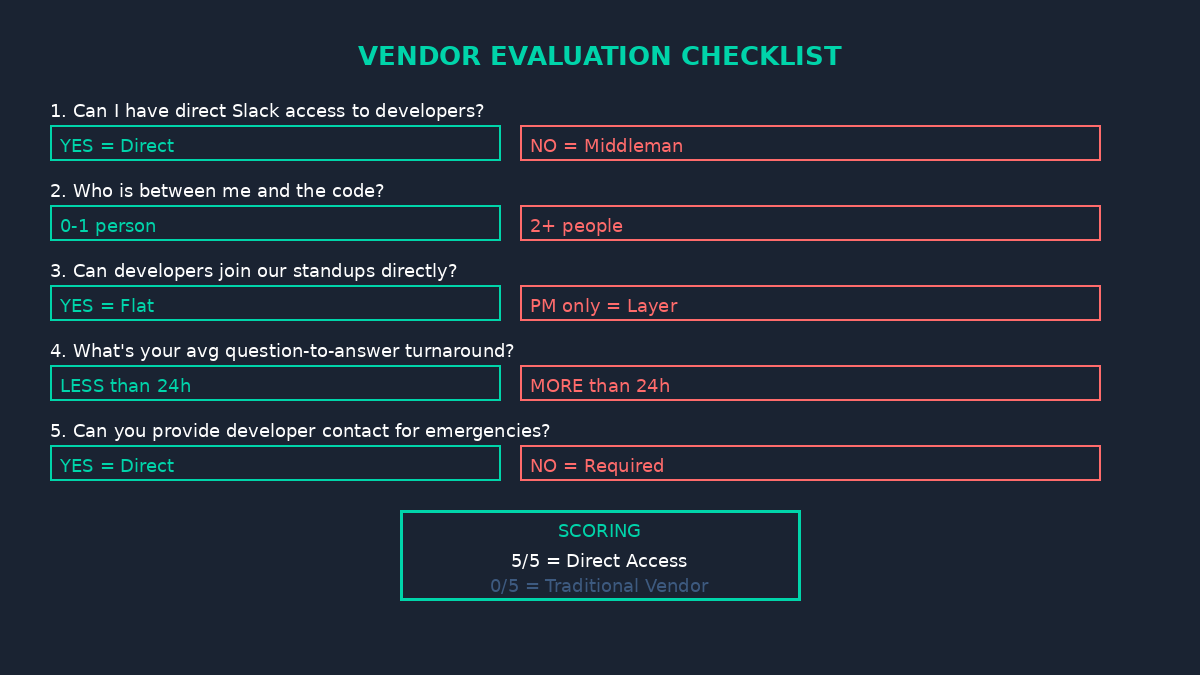
Key questions to ask vendors. If they can’t answer these, walk away:
1. “Can I have direct Slack access to developers?”
- ✅ Yes: Direct access
- ❌ No: Middleman model
2. “Who is between me and the code?”
- ✅ 0-1 person: Direct access
- ❌ 2+ people: Filter problem
3. “Can developers join our standups directly?”
- ✅ Yes: Flat structure
- ❌ Only PM: Layer problem
4. “What’s your average question-to-answer turnaround?”
- ✅ <24 hours: Direct access
- ❌ >24 hours: Filter problem
5. “Can you provide developer contact info for emergencies?”
- ✅ Yes: Direct access
- ❌ No: Middleman required
Red flags: “We’ll handle all communication.” “Don’t worry about the details.” “Our PM is your single point of contact.” These are all middleman language.
The ROI of Cutting Out the Middleman
Let’s quantify the hidden cost:
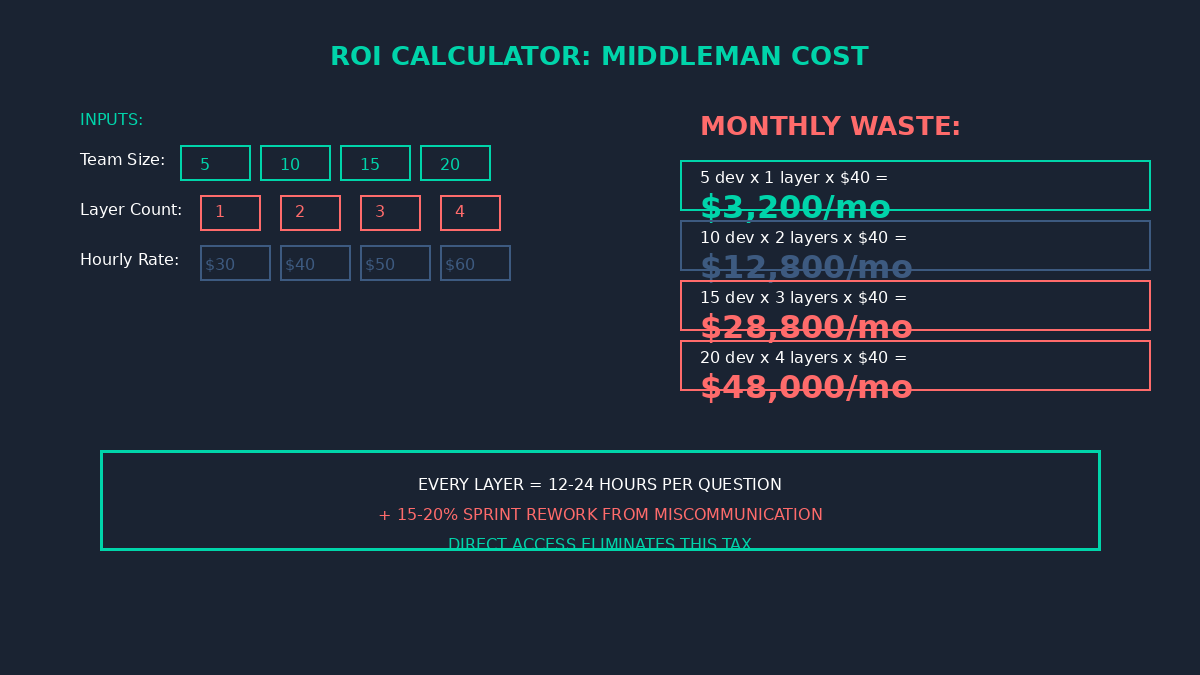
- **Each middleman layer adds ~12-24 hours** to every question. Not because they’re slow—because of handoff delays and context filtering.
- **Miscommunication from context filtering causes rework.** Average: 15-20% of sprint capacity spent fixing misaligned work.
- **”Communication problems” mask real issues** until they’re catastrophic. When every question takes 3 days to answer, you stop asking questions. Problems hide until they explode in production.
ROI calculation:
- **Direct access =** 1 conversation, not 4
- **Time savings:** ~10 hours/week in coordination overhead (no status updates, no PM syncs, no “let me check with the team”)
- **Quality improvement:** 15-20% less rework from clear communication
- **At 15 developers at $40/hr:** That’s ~$24K/month in saved coordination time
- **Even at 5 developers:** ~$8K/month saved
The math is brutal. Middlemen don’t just add delay—they add cost. Every layer is a tax on your communication.
Next Steps
You have three paths. Pick the one that matches where you are:
Path 1 — DIY
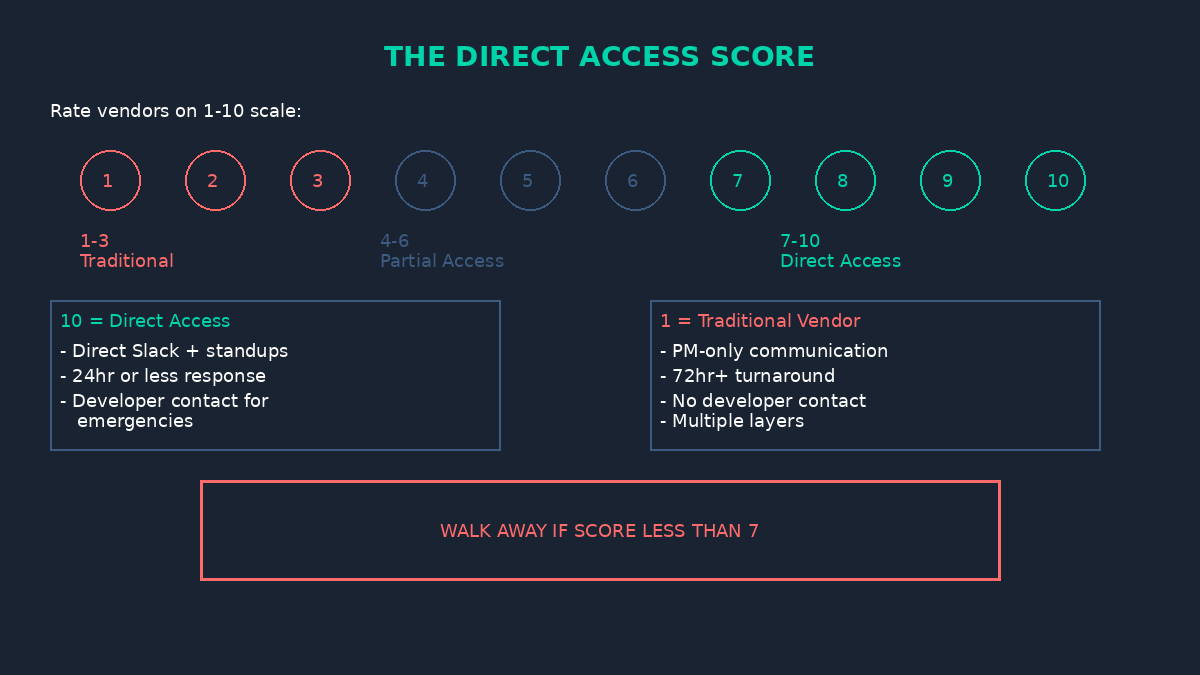
Download the Direct Access Vendor Evaluation Template. It’s a 5-question checklist + scoring matrix. Use it to vet your current or prospective vendor. If they score below 7/10, you have a middleman problem. → [Get the Template]
Path 2 — Guided
GTCatalyst Communication Audit. We analyze your current communication flow, map every middleman layer, and identify specific bottlenecks. 1-week engagement, ~$3K. You’ll know exactly where your communication is leaking time. → [Schedule Audit]
Path 3 — Full Service
GTCatalyst Talent Augmentation. Direct access to vetted developers—no middleman layer. Your PM works directly with our team. Your Slack connects directly to developers. Your standups include them directly. This is what direct access looks like. → Get Direct Developer Access
Related Reading
This article is part of our offshore team success series:
- **[The $150K Hidden Tax: What Your Offshore Team Is Really Costing You](/the-150k-hidden-tax-what-your-offshore-team-is-really-costing-you/)** — The full breakdown of offshore costs most CTOs don’t see coming
- **[15-Point Offshore Partner Evaluation Scorecard](/offshore-partner-evaluation-scorecard/)** — 50-point framework for vetting offshore vendors before you sign
- **[12 Offshore Team Metrics That Predict Failure](/12-offshore-team-metrics-that-predict-failure/)** — The quality dashboard that turns vague concerns into data-driven predictions
- **[AI-Augmented Offshore Teams: 2026 Playbook](/ai-augmented-offshore-teams-2026-playbook/)** — How AI integration is changing the offshore math
- **[The Node.js Microservices Trap](/the-nodejs-microservices-trap/)** — Why architectural choices that work in-house break offshore teams
The timezone isn’t your problem. The middleman is. If you want to see what direct developer access actually feels like, talk to us. We’ll show you the difference.