
Build vs. Buy: The Real Math Behind Running Your Own Offshore Development Center
Most CTOs get the calculation wrong by $400K+ per year. Here’s the model that gets it right.
The Captive Center Dream vs. Reality
You know the vision. Complete control over your engineering team. Deep cultural integration. Full ownership of intellectual property. A dedicated offshore team that feels like an extension of your headquarters rather than a vendor relationship.
It’s compelling. And for some companies, it’s the right answer.
But here’s the dirty secret that Deloitte and KPMG research consistently confirms: 73% of captive offshore centers cost more than outsourcing within the first 2 years.
The math looks simple on the surface—you’re paying $25K/year for an engineer instead of $80K. But that surface-level comparison misses 6 cost categories that quietly add 2-3x to your real expenditure.
The 6 Hidden Cost Categories Most CTOs Miss
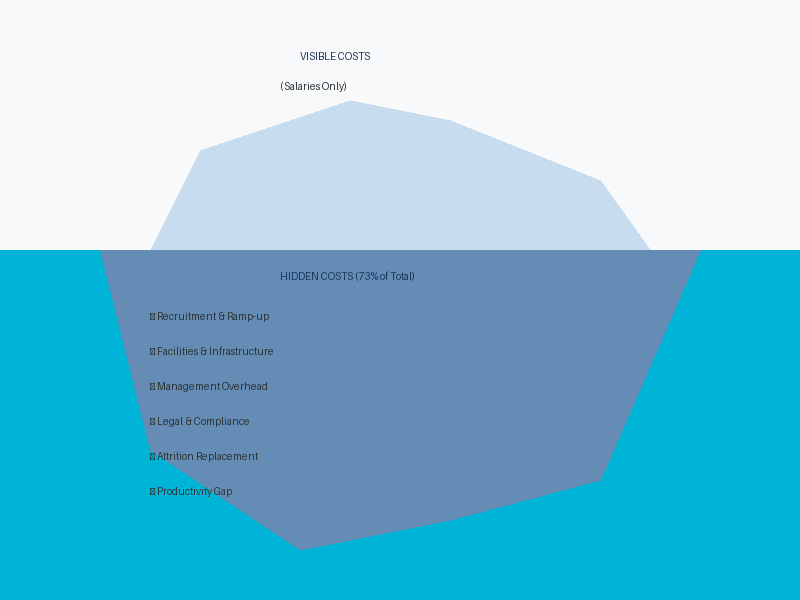
When you build your own offshore development center, you’re not just buying salaries. You’re building an entire infrastructure that includes:
- Recruitment & Ramp-up: $40-80K per hire in agency fees, interviewing time, and 3-6 months of non-productive onboarding
- Facilities & Infrastructure: Office space, utilities, equipment, high-speed internet, security systems—$100-150K/year for a 20-person team
- Management Overhead: Local managers, HR personnel, accounting, legal—the hidden layer that eats budget quietly
- Legal & Compliance: Entity setup, local labor law compliance, tax obligations, corporate governance—$30-60K in year one, $15-30K annually after
- Attrition Replacement: At 15-20% annual attrition in competitive markets, you’re replacing 3-4 engineers per year at $15-25K each in recruiting costs
- Productivity Gap: New hires take 6-12 months to reach full productivity. During that period, you’re paying full salary for partial output
The Full Cost Model: Build Your Own
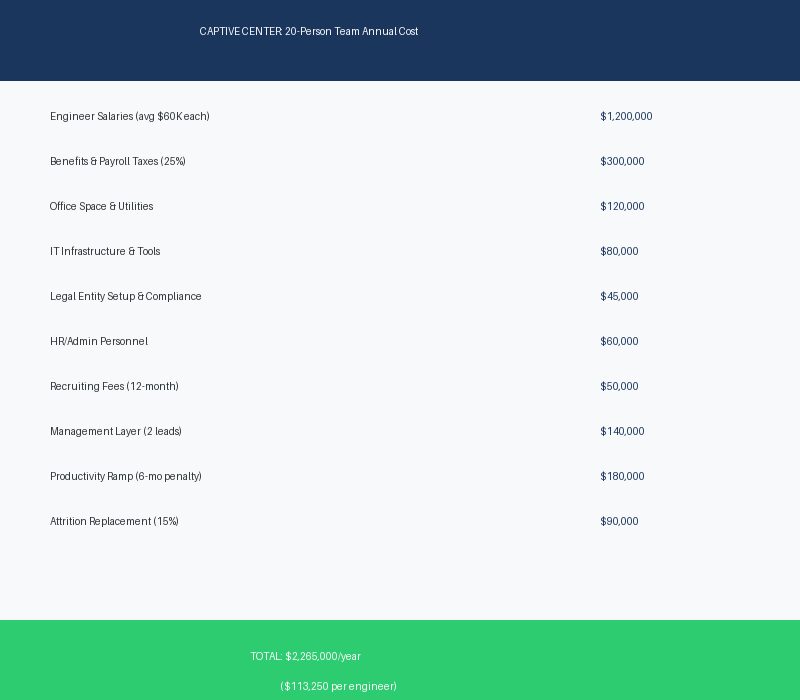
Let’s run the numbers for a 20-person engineering team with a captive offshore center:
| Engineer Salaries (avg $60K each) | $1,200,000 |
| Benefits & Payroll Taxes (25%) | $300,000 |
| Office Space & Utilities | $120,000 |
| IT Infrastructure & Tools | $80,000 |
| Legal Entity Setup & Compliance | $45,000 |
| HR/Admin Personnel | $60,000 |
| Recruiting Fees (12-month) | $50,000 |
| Management Layer (2 leads) | $140,000 |
| Productivity Ramp (6-mo penalty) | $180,000 |
| Attrition Replacement (15%) | $90,000 |
| TOTAL | $2,265,000/year |
Effective cost per engineer: $113,250/year—not the $25K salary you thought you’d be paying.
The Full Cost Model: Partner/Outsource
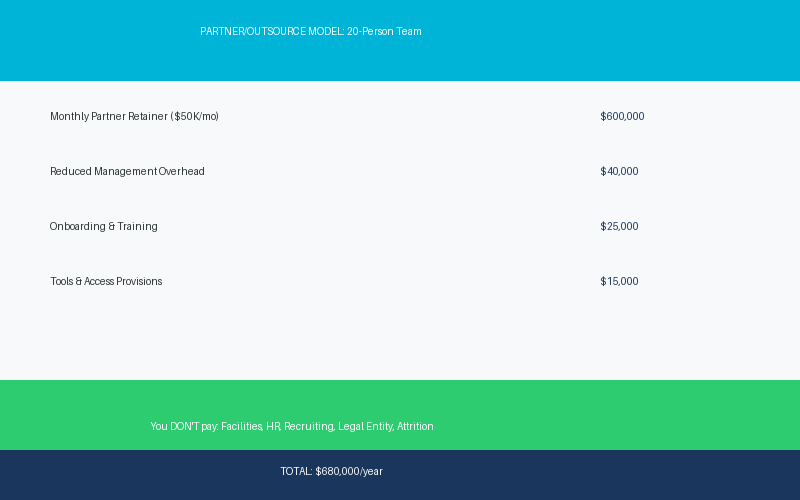
Now let’s look at the same 20-person team through a managed partner model:
| Monthly Partner Retainer ($50K/mo) | $600,000 |
| Reduced Management Overhead | $40,000 |
| Onboarding & Training | $25,000 |
| Tools & Access Provisions | $15,000 |
| TOTAL | $680,000/year |
You DON’T pay: Facilities, HR, recruiting fees, legal entity setup, or attrition backfill. The partner absorbs these costs in their retainer.
Effective cost per engineer: $34,000/year—with zero infrastructure headaches.
Side-by-Side Comparison: 3-Year TCO
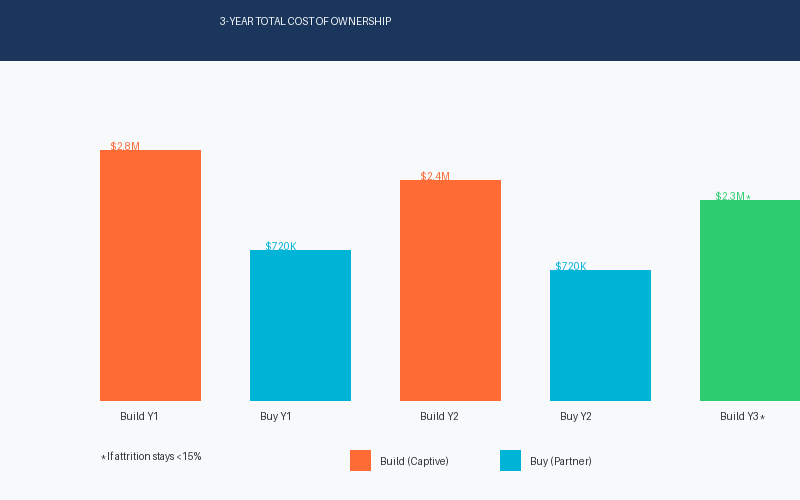
The gap widens further when you look at total cost of ownership over 3 years:
- Year 1: Build = $2.8M (setup costs) vs. Buy = $720K
- Year 2: Build = $2.4M vs. Buy = $720K
- Year 3: Build = $2.3M* vs. Buy = $720K
*If attrition stays below 15%. In reality, most captive centers see 18-25% attrition, pushing Year 3 costs even higher.
The breakeven point: You need 50+ engineers for 3+ years to justify a captive center.
The Decision Framework: When to Build vs. When to Buy
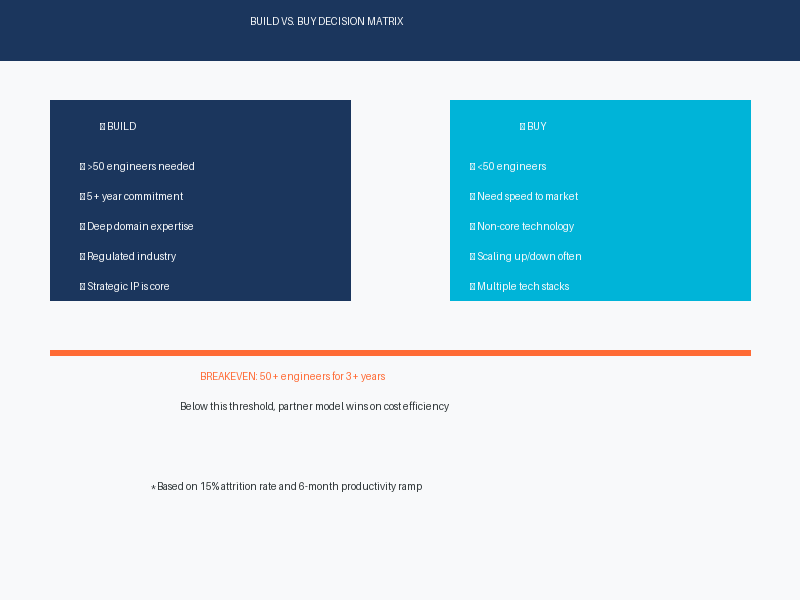
Build (Captive Center) when:
- You need >50 engineers
- 5+ year commitment horizon
- Deep domain expertise in regulated industries (fintech, healthcare, defense)
- Strategic IP is your core competitive advantage
- You have the management bandwidth to run an overseas entity
Buy (Partner Model) when:
- You need <50 engineers
- Speed to market is critical
- Technology is non-core to your competitive strategy
- You need flexibility to scale up/down
- You operate across multiple tech stacks
The rule: Below 50 engineers, the partner model wins on cost efficiency every single time.
The Hybrid Model: Best of Both Worlds
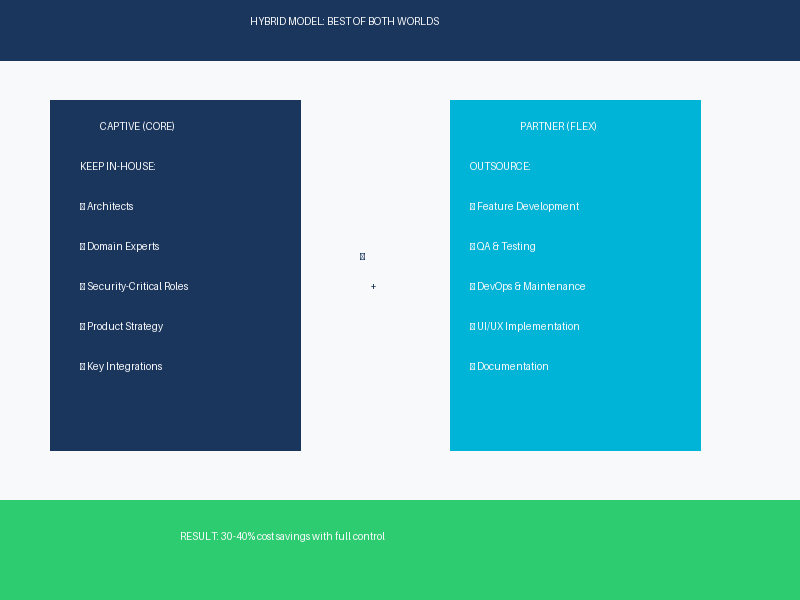
The most successful offshore strategies we’ve seen combine both approaches:
Keep In-House (Captive Core):
- Solutions Architects
- Domain Experts
- Security-Critical Roles
- Product Strategy
- Key Integrations
Outsource to Partner (Flexible Layer):
- Feature Development
- QA & Testing
- DevOps & Maintenance
- UI/UX Implementation
- Documentation
Result: 30-40% cost savings compared to full captive, while maintaining control over what matters most.
The 90-Day Evaluation Process
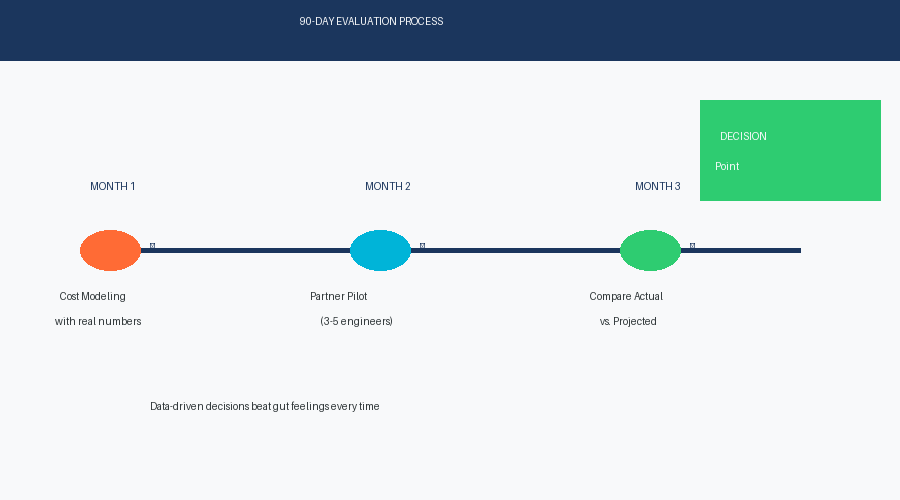
Don’t make this decision on a spreadsheet alone. Run an actual evaluation:
Month 1: Cost Modeling
Build a detailed financial model with your real numbers. Include every hidden cost category from the iceberg model above.
Month 2: Partner Pilot
Engage a managed partner for 3-5 engineers on a specific project. Measure velocity, quality, and communication effectiveness.
Month 3: Compare & Decide
Overlay actual pilot results against your projections. Make the decision with data, not gut feel.
Ready to Run the Numbers?
We’ve helped 40+ companies make this exact decision. We know the hidden costs because we’ve tracked them across dozens of engagements.
Our Offshore Development Consulting team can build a custom cost model for YOUR specific situation—free of charge.
Get your free Build vs. Buy analysis →
Questions about IP protection? See our Security Playbook for Offshore Teams.