
A decision framework for engineering teams drowning in service complexity
By GTCatalyst Team | 5 min read | February 2026
📑 In This Article
That’s a real quote from a startup that nearly went bankrupt from microservices complexity. They’re not alone.
In the last six months, I’ve watched a quiet wave of engineering teams move back to monoliths — or at least dramatically simplify their architectures. The promise was agility. The reality? Most teams ended up slower, not faster.
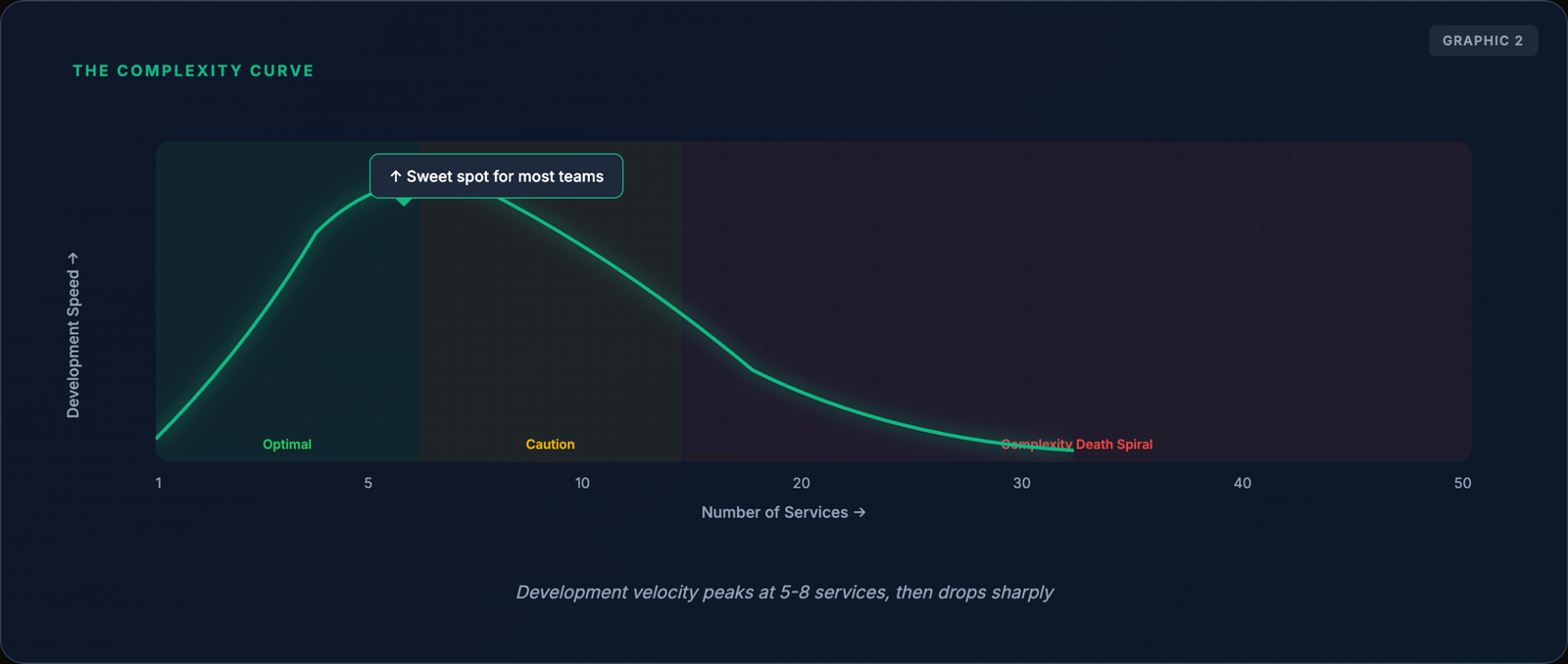
If you’re running 20+ microservices with a team under 30 people, there’s a good chance you’re paying a massive hidden tax.
The Hidden Tax You’re Probably Paying
Every unnecessary microservice costs you:
For a team with 20 services and 10 developers, that’s roughly $150K/year in hidden complexity tax. Not in server costs — in wasted engineering time.
The 4-Test Decision Framework
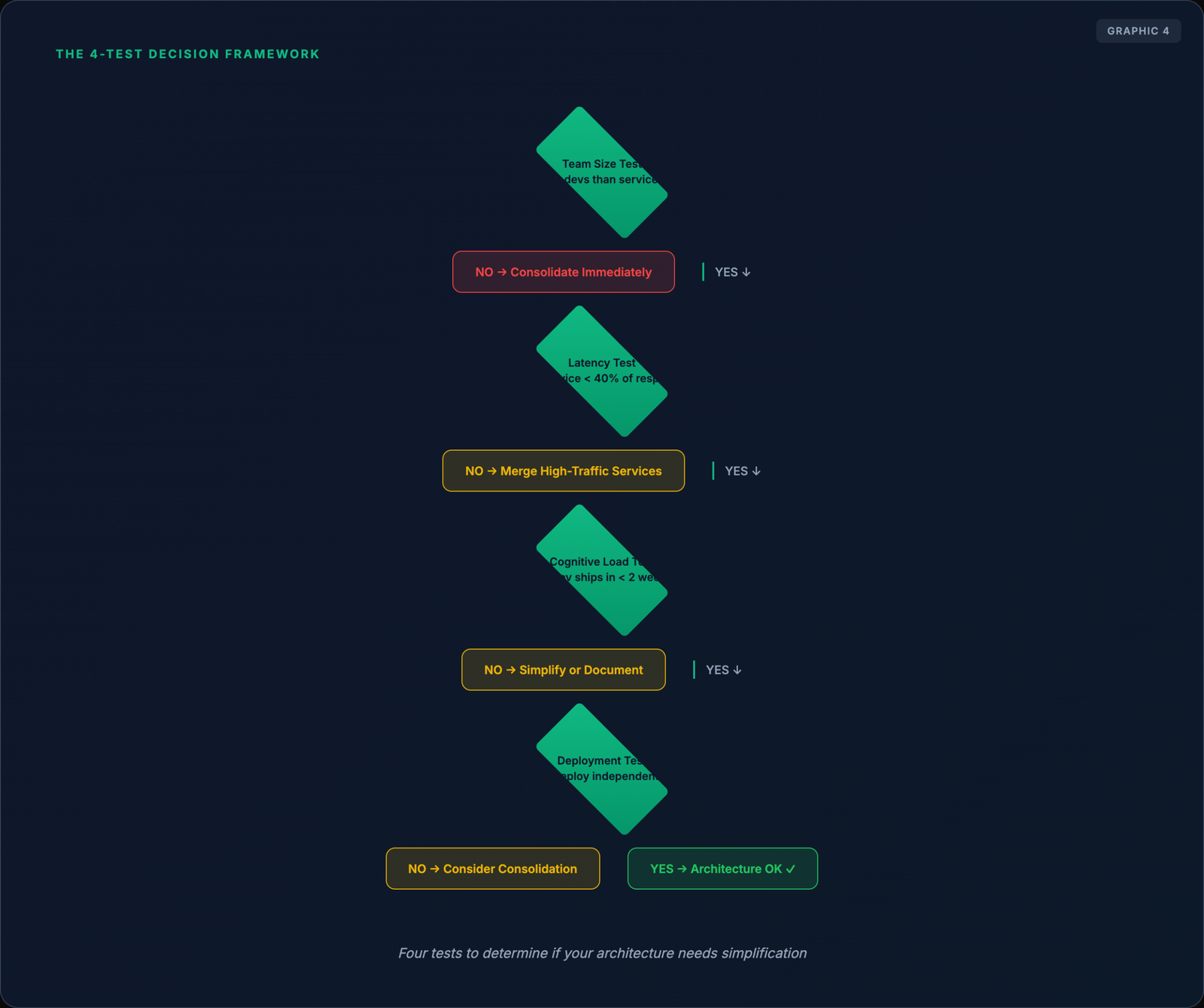
Run these four tests on your current architecture. If you fail any of them, you’re probably over-architected.
Test 1: Team Size Test
Rule: Fewer developers than services = trouble.
Each developer should own at most 2-3 services for effective maintenance. If you’ve got 8 people and 25 services, nobody owns anything properly.
You need to consolidate until you have 2-3x more developers than services.
Test 2: Latency Test
Rule: If inter-service communication is >40% of response time, you’re paying too much for “flexibility.”
Measure a typical user request end-to-end. How much time is spent on actual work versus network hops between services?
Test 3: Cognitive Load Test
Rule: New developer ships a feature within 2 weeks, or your system is too complex.
How long does it take a new hire to understand enough of your architecture to ship something meaningful?
Test 4: Deployment Independence Test
Rule: If you can’t deploy independently, you don’t have microservices — you have a distributed monolith with extra steps.
The Sweet Spot Architecture
Simplification doesn’t mean going back to a single giant monolith. It means right-sizing for your actual team and scale.
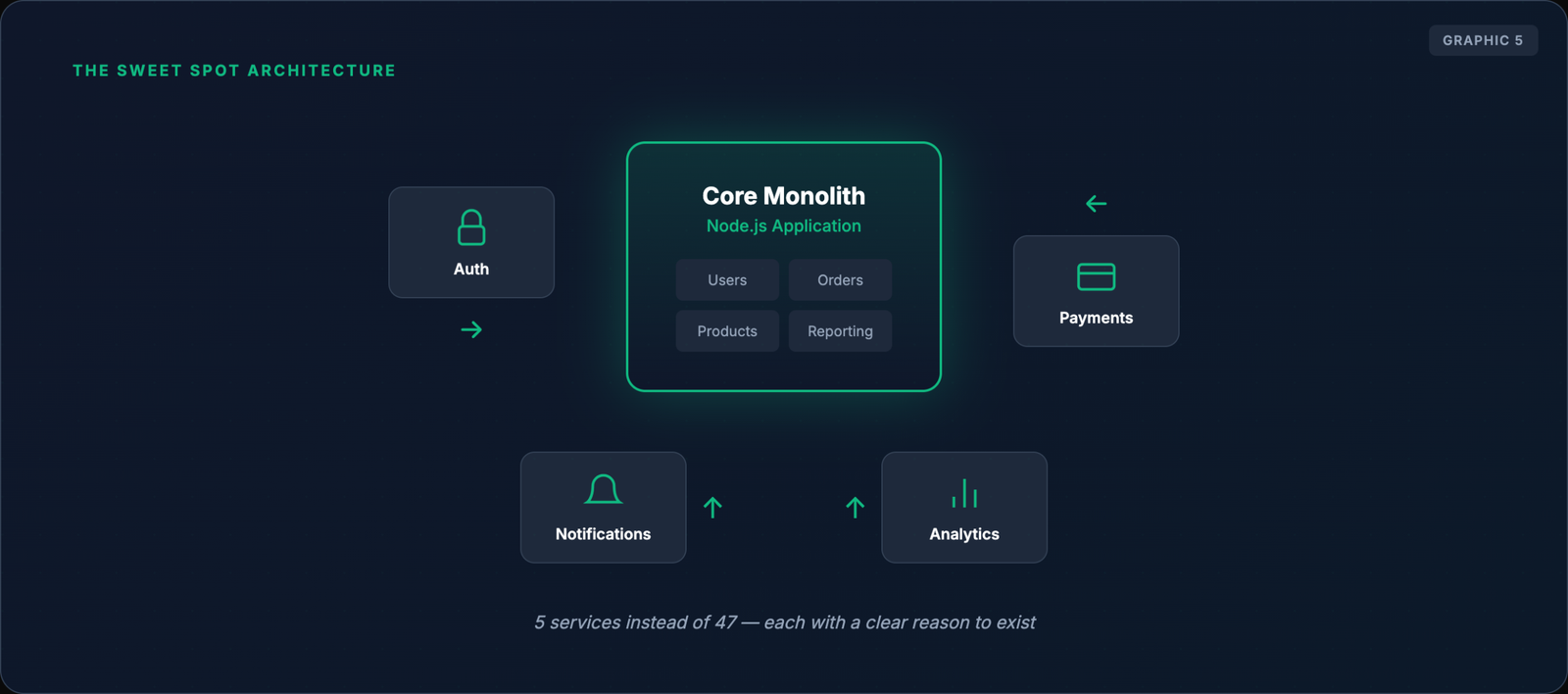
Core Monolith: Your main business logic. About 80% of your code lives here. It’s organized with clear modules, but it’s one deployable unit.
3-5 Bounded Services: Genuinely independent concerns:
- Auth/Identity — security boundary makes sense
- Payments — compliance and audit requirements
- Notifications — different scaling pattern (bursty)
- Analytics — read-heavy, different optimization needs
How to Consolidate (Without Breaking Everything)
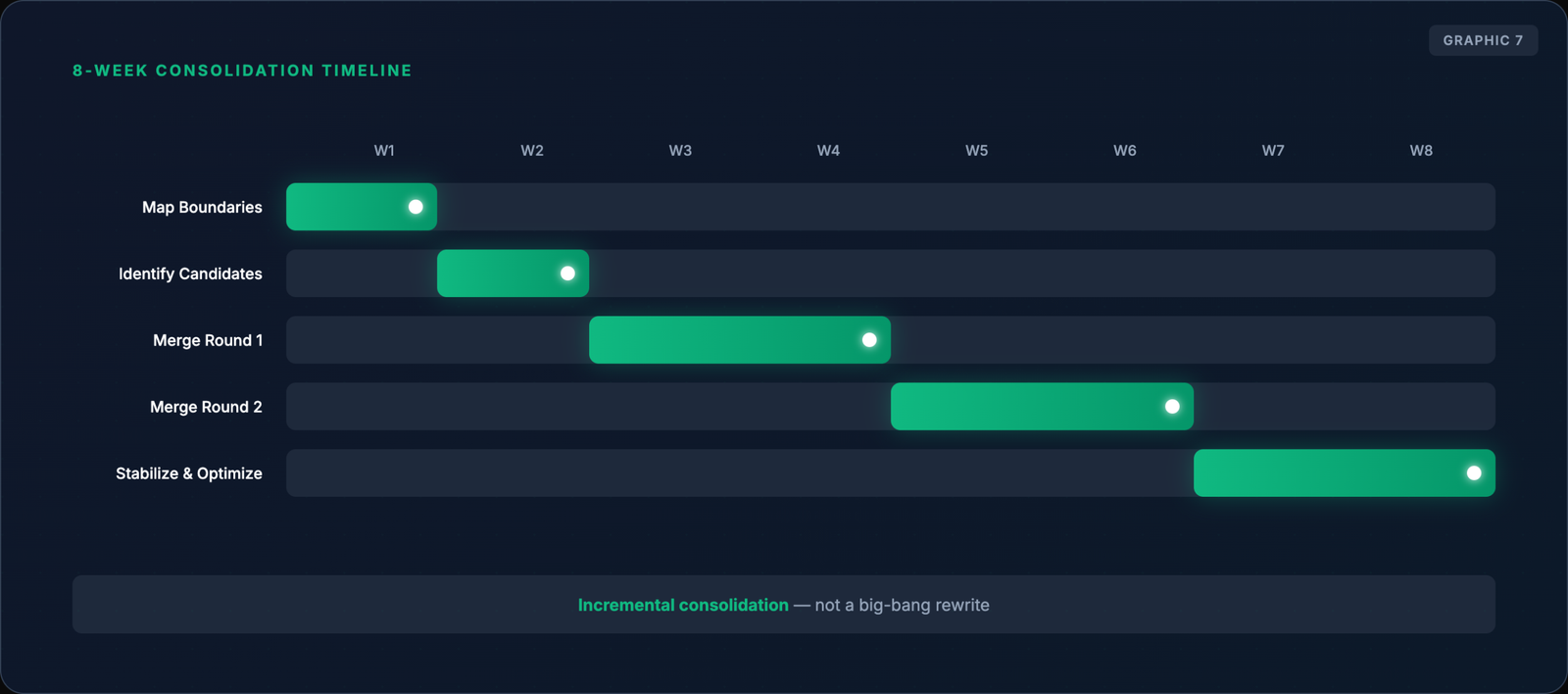
Phase 1: Map Your Boundaries (Week 1)
Document which services actually talk to each other. Draw the lines. You’ll find clusters that are so tightly coupled they might as well be one service.
Phase 2: Identify Candidates (Week 2)
Any service that can’t deploy independently goes on the merge list.
Phase 3: Merge Incrementally (Weeks 3-8)
Don’t big-bang this. Merge one pair of services at a time. Keep the old API contracts working until everything stabilizes.
Why This Actually Works
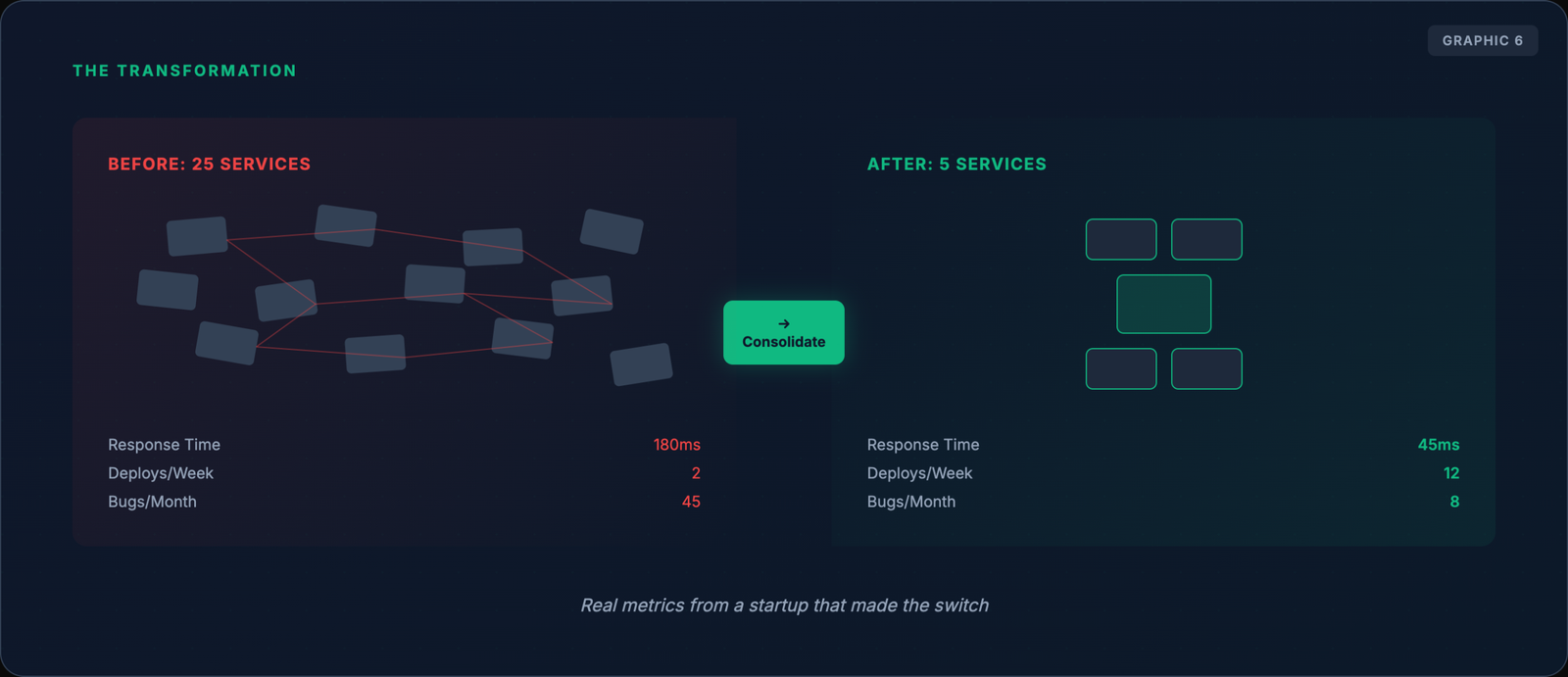
Optimize for your actual constraints, not theoretical scale. You can always extract services later when you have clear evidence you need them.
Five Mistakes That’ll Burn You
- Merging without understanding boundaries. Map your domain first.
- Keeping distributed data. If you merge services, merge their databases too.
- Premature optimization. “We’ll need to scale eventually” is not a reason for complexity today.
- Not measuring. Track response times, deployment frequency, and bug rates before you start.
- Big-bang rewrites. Incremental consolidation is safer. Always.
Get Your Architecture Assessed
Not sure if your architecture needs simplification? Book a free 30-minute architecture review.
GTCatalyst specializes in Node.js development and architecture consulting for mid-size companies. We build systems that are fast to develop and fast to run — without unnecessary complexity.